Professional Trading Education

Complete
Forex Trading Course

Learn Forex Trading, Technical Analysis, Risk Management, Price Action & Market Structure Like a Professional Trader

$7.5T
Daily FX Volume
24/5
Market Open
7+
Modules
100K
Base Currency
~5%
Retail % of Market
180+
Countries

Forex Market Fundamentals | Complete Guide

The foreign exchange market (Forex/FX) is the world's largest and most liquid financial market — trading currencies 24 hours a day, 5 days a week. This module covers everything from scratch: what forex is, who trades it, how it works, all terminology, market structure, broker types, leverage, margin, lot sizes, orders and how trades actually flow. Read every word.

Daily Volume
$7.5T
Larger than all stock markets combined
Market Hours
24/5
Mon open Sydney → Fri close NY
Major Pairs
7+
EUR/USD = 28% of all trades
Standard Lot
100K
Units of base currency
Retail % of Market
~5%
Banks control ~40%, hedgers ~55%
Countries
180+
Currencies traded globally
What is Forex ?

Understanding the Foreign Exchange Market

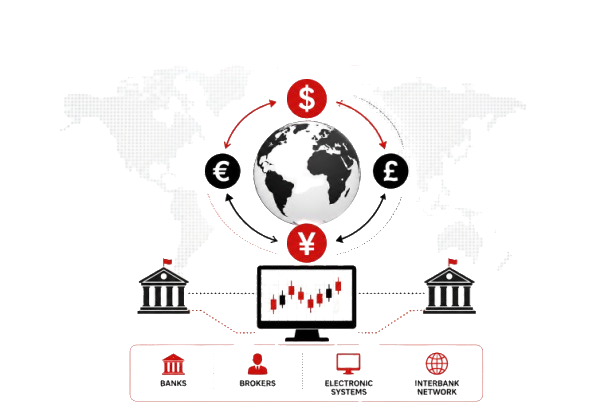
Forex (Foreign Exchange) is the global marketplace where one currency is exchanged for another. Unlike stocks (which trade on centralised exchanges like NYSE), Forex is an OTC (Over-The-Counter) market — meaning there is no single central exchange. Instead, trading happens through a global network of banks, brokers and electronic systems called the interbank network.

Every time a business imports goods from another country, a tourist converts money at an airport, or a central bank adjusts its currency reserves — that is a Forex transaction. Retail traders (like you) participate through brokers who give us access to this interbank market.

Forex Market Fundamentals | Complete Guide

Brief History of Forex
1944 — Bretton Woods : Countries pegged currencies to USD, which was backed by gold ($35/oz).
1971 — Nixon Shock : USA abandoned gold standard. Currencies began floating freely against each other — forex as we know it was born.
1973 — Free Float Era : Major currencies started fluctuating based on supply/demand.
1990s — Electronic Trading : Internet enabled retail traders to access forex markets for the first time.
2000s–Now : MT4/MT5 platforms, ECN brokers, algorithmic trading and mobile apps democratised forex globally.
Why Does Forex Exist?
1. International Trade : A UAE company importing from Japan must convert AED → JPY to pay the supplier. This creates demand for JPY.
2. Tourism & Travel: Tourists exchange currency at airports and banks worldwide — billions of small transactions daily.
3. Investment: A US fund buying German bonds must buy EUR. A British investor in Japanese stocks needs JPY.
4. Speculation : Traders and hedge funds buy/sell currencies to profit from price movements — this accounts for the vast majority of forex volume.
5. Central Bank Policy : buy/sell their own currency to control inflation, support exports and manage reserves.

Who Trades Forex? | Market Participants

Tier 1 | Central Banks (Most powerful)

Federal Reserve (USA), ECB (Europe), Bank of Japan, Bank of England, etc.

What they do : Set interest rates, conduct quantitative easing/tightening and intervene directly in currency markets. A single central bank statement can move EUR/USD 200+ pips in seconds.

Why it matters for you : FOMC, ECB and BOJ meetings are the most important events on the economic calendar. Learn to trade around them.

Learn About Commissions

Tier 3 | Hedge Funds & Institutions

What they do : Trade currencies for speculation and portfolio hedging. Hedge funds are the most aggressive — they can move markets with massive position sizes ($100M+).

George Soros example : In 1992, Soros shorted the British Pound with $10 billion, forced the UK to exit the European Exchange Rate Mechanism and made $1 billion in a single day.

Bridgewater, Renaissance Technologies, BlackRock, pension funds, sovereign wealth funds.

Learn About Commissions

Tier 5 | Retail Brokers

Zed Capital, IC Markets, Pepperstone, XM, FXCM, IG, Oanda, etc.

What they do : Provide retail traders access to the interbank market. They aggregate liquidity from multiple banks and pass orders through to the market (ECN/STP) or trade against their clients internally (Market Maker).

Revenue : Brokers earn from spreads, commissions, swap fees, and (for market makers) from client losses.

Learn About Commissions

Tier 2 | Commercial Banks

JPMorgan, Citibank, Deutsche Bank, HSBC, Barclays, Goldman Sachs.

What they do : Make markets by providing bid/ask quotes to other banks and institutional clients. They hold huge inventories of currencies and profit from the bid-ask spread across millions of transactions daily.

Interbank market : Banks trade directly with each other via platforms like EBS and Reuters Matching. Retail traders cannot access this — we go through brokers.

Tier 4 | Corporations (Hedgers)

Apple, Toyota, Airbus, Saudi Aramco, any multinational company.

What they do : Companies with international revenues hedge their currency exposure to protect profits. Apple earns billions in EUR but reports in USD — they buy USD/sell EUR forward contracts to lock in exchange rates.

Why this creates opportunity : Corporate hedging creates predictable currency flows at month/quarter end. Smart traders watch these "flow" patterns.

Tier 6 | Retail Traders

Individual traders worldwide — day traders, swing traders, algorithmic traders.

Reality check : Retail traders represent only ~5% of total forex volume. We are the smallest fish in the ocean. This is why understanding how larger players operate (Smart Money Concepts) is critical for edge.

Our advantage : Small size = we can enter and exit without moving the market. A $10,000 account can achieve much better % returns than a $10 billion fund.

Market Sessions | Full Infographic

Forex is open 24 hours a day, 5 days a week. The market is a sequencing of sessions. Volatility and volume peak during the London–NY overlap (13:00–17:00 GMT) — the golden trading window.

Sydney Session
22:00–07:00 GMT
Best pairs: AUD/USD, NZD/USD, AUD/JPY
Thin liquidity, wide spreads possible, mostly continuation of Friday's trends. News from Australia and New Zealand moves AUD/NZD pairs. RBA (Reserve Bank of Australia) statements are key events.
High Impact News
Tokyo Session
00:00–09:00 GMT
Best pairs: AUD/USD, NZD/USD, USD/JPY, EUR/JPY
Characteristics: Thin liquidity, price spreads possible, mostly consolidation. Today's levels: Monitor NZD (Reserve Bank of Australia) statements as key events.
Asian Session
London Session
08:00–17:00 GMT
Best pairs: GBP/USD, EUR/USD, EUR/GBP, EUR/JPY
Characteristics: Highest volatility session. Bank of Japan (BoJ) interventions happen. H4 structure breaks. TP move. Price often sets the day's high or low. London sets key levels that often holds all week.
Most Active
New York Session
13:00–22:00 GMT
Best pairs: EUR/USD, GBP/USD, USD/CAD, USD/CHF
NFP, CPI, FOMC news drops here. Second most liquid session. Overlapping with London 13:00–17:00 creates the highest volume window of the entire trading week.
High Impact News
Best Times to Trade
London Open: 08:00–10:00 GMT
EUR/USD, GBP/USD, Gold — highest breakout probability
NY Open: 13:00–16:00 GMT
Avoid: 22:00–00:00 GMT (thin, manipulated spreads)
Never trade 30 mins before major news releases.

Core Terminology | Every Term Explained

PIP — Price Interest Point
What is a Pip?

A pip is the smallest standardised unit in a currency pair. For most pairs: 1 pip = 0.0001 (the 4th decimal place). For JPY pairs: 1 pip = 0.01 (the 2nd decimal place).

Examples
EUR/USD moves from 1.0800 → 1.0830 = 30 pips
GBP/JPY moves from 192.40 → 193.10 = 70 pips
Pip value (1 lot) = $10 per pip on EUR/USD

Modern brokers quote 5 decimal places (pipettes) — the 5th digit = 0.1 pip. Pip value in dollars depends on lot size.

LOT SIZE — Full Breakdown with Values
Lot Sizes Explained
Lot Type Units Pip Value (EUR/USD) For accounts
Standard 100,000 $10 per pip $10,000+
Mini 10,000 $1 per pip $500–10,000
Micro 1,000 $0.10 per pip $50–$1,000
Nano 100 $0.01 per pip Practice
Practical Example
You have $500. If you risk 1% = $5 risk per trade. With 30-pip SL: lot size = 5÷(30×1) = 0.17 mini lots
Base Currency vs Quote Currency

In any currency pair: BASE/QUOTE

EUR/USD = 1.0850 means:
→ 1 EUR (base) = 1.0850 USD (quote)
→ To BUY 1 EUR, you PAY 1.0850 USD
USD/JPY = 150.00 means:
→ 1 USD (base) = 150.00 JPY (quote)
→ To BUY 1 USD, you PAY 150 JPY

When you BUY EUR/USD: You are simultaneously BUYING EUR and SELLING USD.

When you SELL EUR/USD: You are simultaneously SELLING EUR and BUYING USD.

This is why forex is always traded in pairs — you can never buy one currency without selling another.

Long vs Short — Both Directions

Unlike stocks (where you can only profit when price goes UP), forex allows profit in BOTH directions.

LONG (Buy):
→ You believe the base currency will RISE vs the quote.
→ Buy EUR/USD at 1.0800, sell at 1.0900 → +100 pips profit
→ You benefit from EUR strengthening OR USD weakening.
SHORT (Sell):
→ You believe the base currency will FALL vs the quote.
→ Sell EUR/USD at 1.0900, buy back at 1.0800 → +100 pips profit
→ You benefit from EUR weakening OR USD strengthening.

Key insight: In a downtrend, shorting is just as natural as buying in an uptrend. Professional traders are completely comfortable going short — most beginners only think about buying.

Spread
Bid / Ask Spread

The spread is the difference between the Bid price (sell) and Ask price (buy). This is your broker's cost. ECN brokers offer raw spreads (0.0–0.3 pips) + commission. MM brokers include markup in the spread.

Leverage & Margin
Leverage & Margin

Leverage = how much capital your broker multiplies. 1:100 leverage = $1,000 controls $100,000. Margin = the deposit required. A 1% margin means $1,000 for a $100,000 position. Free margin = Equity − Used margin.

Swap / Rollover
Overnight Swap Rate

When you hold a position past 5:00 PM New York time, your broker applies a swap charge or credit based on the interest rate differential between the two currencies. Wednesday swap is 3× (for weekend). Some brokers offer swap-free accounts.


Broker Types | Which One Should You Use?

Market Maker (MM)
Market Maker

They take the other side of your trade. Your trades may never reach the real market. Trader may requote. Fixed spreads. Conflict of interest — they profit when you lose.

STP Broker
Straight-Through Processing

They profit from your losses — the spread. No dealing desk, trades pass straight to market. No requotes. Variable spreads. Better than MM for active traders.

ECN Broker ✓ Recommended
Electronic Comm. Network

Your orders are sent directly to liquidity providers (banks). Raw spreads from 0.0 pips + small commission ($3–7/lot). Most transparent. Best for serious traders.

Spread Betting
Spread Betting

Variable spreads. No requotes, faster execution than MM. Sigma: Variable spreads, no requotes, faster than market maker. Vantage: Good middle ground for swing and most conservative traders.


Currency Pairs | Full Classification

Category Pairs Characteristics Typical Spread Daily Range Best For
Major
EUR/USD · GBP/USD
USD/JPY · USD/CHF
AUD/USD · USD/CAD · NZD/USD
Highest liquidity globally. Most analysed. Tightest spreads. 0.5–1.5 pips 50–150 pips All traders
Minor
EUR/GBP · GBP/JPY
EUR/JPY · AUD/JPY
Less liquidity, wider spreads. Offer unique opportunities. 1.5–3 pips 80–200 pips Intermediate
Exotic
USD/TRY · USD/ZAR
USD/MXN · EUR/NOK
Very low liquidity, very wide spreads. High risk. Prone to manipulation. 5–50 pips 100–500+ pips Advanced only
Commodity-linked
AUD/USD (gold) · USD/CAD (oil)
NZD/USD (dairy)
These currencies are heavily influenced by commodity prices. Gold up → AUD up. Oil up → CAD up. 0.5–2 pips 40–100 pips All levels

How a Forex Trade Works | Step by Step

1
Analyse the Market

Use top-down analysis — start Monthly/Weekly for the macro trend, Daily for key levels, H4/H1 for trade setup. Identify whether you're in a trending, ranging, or transitioning market.

2
Calculate Position Size

Practical example (Lot Size Formula):
You have $500 account. Risk 1% = $5 per trade. SL = 20 pips → Lot size = 5 ÷ (20 × 1) = 0.25 mini lots

3
Calculate lot size: Run = $20 – SL = 20 pips/trade setup

Set SL: $20.00 at market or as a limit order. TP at next key level. Set the R:R before placing the trade — minimum 1:2 RRR. If you can't find a clean 1:2 setup, skip the trade.

4
Place order

Buy 0.33 lots EUR/USD at market price 1.08502 (ask)

5
Set SL

1.0820 (30 pips below entry)

6
Set TP

1.0940 (90 pips above entry → 3:1 RRR)

7
Margin used

0.33 × 100,000 × 1.0850 ÷ 100 = $357.55 locked up

8
Free margin

$10,000 − $357.55 = $9,642 still available

9
Trade outcome A

Price hits TP at 1.0940 → 90 pips × $0.33/pip (mini) × 10 = +$297 profit (+2.97%)

10
Trade outcome B

Price hits SL at 1.0820 → −30 pips × $3.30 = −$99 loss (−0.99% of account ✅ within 1% risk)


Order Types | Complete Guide with When to Use Each

Market Order
Market Order

Executes immediately at the current best available price. Use when: You need instant fill and precise price isn't critical. Risk: Slippage during fast market moves.

Buy Limit
Buy Limit

Place a buy order at a lower price than current. Refer to your broker at a fixed value for slippage → guaranteed fill at your price or better. Use: When you want to buy at support, a fair value gap, or discount zone.

Sell Limit
Sell Limit

Places a sell order at a price ABOVE current market price. Waits for price to rally to your resistance level. Use when: You want to sell at resistance without chasing price. Patient entry strategy.

Buy Stop
Buy Stop

Place a buy order above current price. Executes when price rises to that level. Use: When a breakout above resistance confirms your bias — guaranteed fill once level is hit.

Sell Stop
Sell Stop

Places a sell order at a price BELOW current market price. Triggers on a downside breakout. Use when: You want to short only if price breaks below a key support level.

Stop Loss (SL)
Stop Loss — Non-Negotiable

An order that automatically closes your trade if price moves against you. Place below structure (buy trades) or above structure (sell trades). Never trade without a stop loss — the market will move against you eventually.

Take Profit (TP)
Take Profit

Automatically closes your trade at a target profit level. Place at the next key level of S/R. TP1 = 50% partial close. TP2 = full close. This locks in profits without watching the screen.

Trailing Stop
Trailing Stop

A dynamic stop loss that moves with price as it goes in your favour — but stays locked if price reverses. Use on strong trend trades to lock in profit while letting winners run.

OCO — One Cancels Other

Two pending orders placed simultaneously. When one triggers, the other is automatically cancelled. Use when: You don't know which direction price will break. Place Buy Stop above resistance AND Sell Stop below support → whichever breaks first, that trade executes and the other cancels.


Fundamental Analysis | What Moves Forex

Interest Rates | The #1 Driver
Central bank interest rates are the single most powerful driver of long-term currency direction.

Rule: Higher interest rates → currency attracts more foreign investment → demand for currency rises → currency STRENGTHENS.

Example: When the US Federal Reserve raised rates from 0% to 5.25% (2022–2023), the USD Index (DXY) surged to 20-year highs. EUR/USD dropped from 1.1000 to 0.9600 — a 1,400 pip move driven almost entirely by rate differentials.

FOMC meetings: 8× per year · Rate decision + statement + press conference. These are the most important market events. Plan all trades around them.
Key Economic Indicators
NFP — Non-Farm Payrolls (USA): First Friday of each month at 13:30 GMT. Shows jobs created/lost. A huge beat → USD strengthens. A big miss → USD weakens. Spreads widen massively at release — widen SL by 30–50 pips or stay out.

CPI — Consumer Price Index: Inflation measure. High CPI → central bank may raise rates → currency strengthens.

GDP: Gross Domestic Product. Strong growth → rate hike expectations → currency up.

PMI (Purchasing Managers Index): Above 50 = expansion. Below 50 = contraction. Strong leading indicator.

Retail Sales, Trade Balance, Unemployment Rate: All move currencies proportionally to how much they surprise vs expectations.
Geopolitical & Sentiment Factors
Risk-On vs Risk-Off:
Risk-ON (markets calm, optimistic) → Traders buy AUD, NZD, EM currencies. Sell JPY, CHF, USD.
Risk-OFF (crisis, fear, uncertainty) → Traders flee to JPY, CHF, USD as "safe havens." Sell AUD, NZD.

Wars & Conflicts: Ukrainian war (2022) → EUR weakened significantly (Europe's energy supply threatened). Swiss Franc surged (safe haven).

Elections: UK Brexit vote (2016) — GBP/USD crashed 1,800 pips in 24 hours. Political uncertainty = currency weakness.

Oil prices: Oil ↑ → USD/CAD falls (CAD strengthens). Canadian dollar is the "petrodollar."
Economic Calendar | How to Use It
Use Forex Factory, Investing.com, or TradingEconomics to track all upcoming events.

Impact levels:
High Impact — Can move pairs 50–300+ pips (NFP, FOMC, CPI)
Medium Impact — 20–60 pip moves possible
Low Impact — Usually no significant move

How to trade around news:
1. Mark all high-impact events for the week on Sunday.
2. Don't open new trades 30 min before high-impact news.
3. Either close open trades or widen SL by 2–3× before release.
4. Wait 5–15 min after release for initial spike to settle before entering.
5. Best moves often happen 15–60 min after release as the "real" direction establishes.

Trading Styles | Which One Suits You?

Style Timeframes Holding Period Trades/Week SL Size Best For
Scalping
M1, M5 Seconds – Minutes 20–100+ pips 5–15 pips Requires fast execution, ECN broker, VPS. High stress.
Day Trading
M15, H1 Hours (closed daily) 1–5 pips 15–40 pips No overnight risk. Clear stop loss. Best for working traders.
Swing Trading
H4, D1 Days to weeks 1–10 pips 30–100 pips Less screen time, larger targets, psychological pressure from holding.
Position Trading
W1, MN Weeks to months <5 pips 100–300 pips Fundamental analysis focus (large S/R levels). Patient traders only.

Demo Account vs Live Account | A Critical Difference

Demo account — start here

A demo account uses virtual money with real market prices. It is identical to a live account in terms of charts, indicators and order types — but there is NO emotional weight because you cannot actually lose real money.

How long on demo?

Until you are consistently profitable for at least 3 months. Not 3 weeks — 3 months. Track every trade in a journal.

Treat it like real money

The biggest mistake beginners make on demo is overtaking risks they'd never take with real money. If you won't do it on live, don't do it on demo either.

Live account — the psychological shift

When you move to a live account with real money, everything changes psychologically. Winning strategies on demo often fail on live because fear and greed take over.

How to transition

  1. 1Start with the smallest amount you can deposit (some brokers allow $50–$100)
  2. 2Trade micro lots (0.01) only
  3. 3Maintain exact same rules as demo
  4. 4Scale up only after 3 months of live profitability
Reality: Most traders blow their first live account. It's almost a rite of passage. The lesson is always the same: risk management and psychology, not the strategy.

Prop Firms | Trade with Funded Capital

What is a Prop Firm (Proprietary Trading Firm)?
Prop firms provide traders with large funded accounts ($25K–$200K+) in exchange for passing a trading challenge and sharing a % of profits. You risk their money, not yours.

Popular prop firms: FTMO, MyForexFunds (closed), The Funded Trader, E8 Funding, True Forex Funds, Topstep.

Typical challenge rules:
— Max daily drawdown: 5% · Max total drawdown: 10%
— Minimum trading days: 10
— Profit target: 8–10% to pass
— Profit split: 70–90% to trader

Strategy: Master your edge on a small live account first. Then use a prop firm to scale up without risking large personal capital. This is how many retail traders go from small accounts to trading $100K+ accounts.

Zed Capital — Forex Basics FAQ

Zed Capital — Forex Basics FAQ

Everything beginners need to know before placing their first trade on Zed Capital's MT5 platform. Click any question to expand.

Showing all 20 questions Explore Zed Academy →
1
What is Forex trading?
Forex (Foreign Exchange) is the global marketplace where currencies are bought and sold against each other. It is the world's largest financial market with a daily trading volume of over $7.5 trillion — larger than all stock markets combined.

Unlike stock markets, Forex is an OTC (Over-The-Counter) market with no single central exchange. Trading happens 24 hours a day, 5 days a week through a global network of banks, brokers, and electronic systems.
On Zed Capital, you can trade Forex, Stocks, Metals, Indices, Commodities and Crypto — all from one MT5 account.
2
Who participates in the Forex market?
The Forex market has a clear hierarchy of participants:

TierParticipantRole
1Central Banks (Fed, ECB, BOJ)Set interest rates, control currency supply
2Commercial Banks (JPMorgan, HSBC)Make markets, provide liquidity
3Hedge Funds & InstitutionsLarge-scale speculation & hedging
4Multinational CorporationsHedge currency exposure on international revenues
5Retail Brokers (Zed Capital)Provide market access to retail traders
6Retail Traders (You)~5% of total market volume
Retail traders represent only ~5% of Forex volume — which is why understanding how larger players move the market gives you a significant edge.
3
Why does the Forex market exist?
Forex exists for five core reasons:

1. International Trade — A UAE company importing goods from Japan must convert AED to JPY to pay their supplier.
2. Tourism — Travellers exchange currency when visiting other countries — billions of small transactions daily.
3. Investment — A US fund buying European bonds must first purchase EUR.
4. Speculation — Traders and hedge funds buy/sell currencies to profit from price movements. This accounts for the majority of Forex volume.
5. Central Bank Policy — Countries manage their currency's value to control inflation and support exports.
4
What is a Pip and how is it calculated?
A Pip (Price Interest Point) is the smallest standardised price movement in a currency pair.

For most pairs → 1 pip = movement of the 4th decimal place (0.0001)
For JPY pairs → 1 pip = movement of the 2nd decimal place (0.01)

Examples:
EUR/USD moves from 1.0850 → 1.0860 = +10 pips profit (if long)
GBP/USD moves from 1.2700 → 1.2650 = −50 pips loss (if long)
USD/JPY moves from 150.00 → 151.00 = +100 pips profit (if long)

Modern brokers like Zed Capital quote to 5 decimal places. The 5th digit is a "pipette" = 1/10th of a pip. e.g. EUR/USD at 1.08512 — the "2" is a pipette.
5
What is a Spread and how does it affect my trades?
The spread is the difference between the Bid price (what you sell at) and the Ask price (what you buy at). It is your broker's primary cost.

Example — EUR/USD:
Bid: 1.08500 | Ask: 1.08515 → Spread = 1.5 pips

Every trade you open starts at a small loss equal to the spread. The market must move in your favour by at least the spread before you break even.

AccountSpreadCommissionBest For
Zed Capital Premium EliteFrom 1.5 pips$0Beginners, Swing Traders
Zed Capital Premium RawFrom 0.1 pips$8/lotScalpers, Algo Traders
6
What is Leverage and how does it work?
Leverage allows you to control a larger position with a smaller amount of capital. Zed Capital offers leverage up to 1:500.

Example with 1:100 leverage:
You deposit $1,000. With 1:100 leverage, you can control a $100,000 position.
If the trade moves +1% in your favour → profit = $1,000 (100% of your deposit).
If the trade moves −1% against you → loss = $1,000 (entire deposit wiped).

⚠️ Leverage is a double-edged sword. It amplifies both profits AND losses. Always use a Stop Loss. Professional traders rarely use more than 1:10–1:20 effective leverage regardless of what their broker offers.
Zed Capital includes negative balance protection — you cannot lose more than your deposit.
7
What is Margin and what happens when I get a Margin Call?
Margin is the deposit your broker holds as collateral to keep your trade open. It is not a fee — it is reserved from your account balance.

Required Margin formula:
Required Margin = (Trade Size ÷ Leverage) × Exchange Rate

Example: Trading 1 lot EUR/USD (100,000 units) at 1:100 leverage → Required Margin = $1,000

Margin Call occurs when your account equity drops to 50% of the required margin (Zed Capital's margin call level). The broker alerts you to deposit more funds or close positions.

Stop Out occurs at 50% — Zed Capital will automatically close your positions to prevent further losses.
Always keep free margin well above your used margin. A common rule: never use more than 20% of your account on any single trade.
8
What are Lot Sizes? (Standard, Mini, Micro)
A Lot is the standard unit of trade size in Forex. On Zed Capital's MT5 platform, the Volume field controls your lot size.

Lot TypeMT5 VolumeUnitsPip Value (EUR/USD)
Standard Lot1.0100,000~$10/pip
Mini Lot0.110,000~$1/pip
Micro Lot0.011,000~$0.10/pip
Beginners should always start with micro lots (0.01). With a $500 account and a 30-pip stop loss: 0.01 lot = $0.30 risk per pip × 30 pips = $3 total risk = 0.6% of account. This is safe and professional.
9
What is a Swap / Rollover fee?
A Swap (Rollover) is an interest charge or credit applied when you hold a Forex position past 17:00 New York time. It is based on the interest rate difference between the two currencies in the pair.

Example — Buying EUR/USD:
You buy EUR (ECB rate ~4%) and sell USD (Fed rate ~5.25%)
Net = 4% − 5.25% = −1.25%/year → You PAY swap daily

Wednesday Triple Swap: On Wednesday night, brokers charge 3× the normal swap to cover the weekend settlement. Avoid holding negative-swap trades through Wednesday.

Zed Capital offers Islamic (swap-free) accounts for traders who cannot receive or pay interest under Sharia law.
10
What is the difference between Base Currency and Quote Currency?
Every currency pair is written as BASE/QUOTE.

EUR/USD = 1.0850 means:
→ 1 EUR (base) = 1.0850 USD (quote)
→ To BUY 1 EUR, you pay 1.0850 USD

When you BUY EUR/USD — you buy EUR and simultaneously sell USD.
When you SELL EUR/USD — you sell EUR and simultaneously buy USD.

This is why Forex always trades in pairs — you can never buy one currency without selling another.
11
What are Major, Minor, and Exotic currency pairs?
CategoryExamplesSpreadVolatility
MajorEUR/USD, GBP/USD, USD/JPY, AUD/USDTightestModerate–High
MinorEUR/GBP, EUR/JPY, GBP/JPY, AUD/JPYModerateModerate
ExoticUSD/TRY, EUR/ZAR, USD/SGDWidestVery High

Best pairs for beginners: EUR/USD (most liquid, tightest spread), GBP/USD, USD/JPY.

Start with just 1–2 pairs. Master their behaviour before adding more. EUR/USD accounts for ~28% of all global Forex trades.
12
What is the difference between Going Long and Going Short?
Unlike stocks (where you typically only profit when prices rise), Forex allows you to profit in both directions.

LONG (Buy): You believe the base currency will RISE. Buy EUR/USD at 1.0800, close at 1.0900 → +100 pips profit.

SHORT (Sell): You believe the base currency will FALL. Sell EUR/USD at 1.0900, close at 1.0800 → +100 pips profit.

Professional traders are equally comfortable going short. In a downtrend, shorting is as natural as buying in an uptrend. Most beginners only think about buying — this limits their opportunities by 50%.
13
What is the difference between Market Maker, STP, and ECN brokers?
TypeExecutionSpreadCommissionVerdict
Market MakerBroker takes other sideFixed, widerNoneConflict of interest
STPRouted to liquidity providersVariableMarkup on spreadGood middle ground
ECN/STPTrue interbank accessRaw (0.0+)Fixed per lotBest for serious traders
Zed Capital is a licensed STP broker regulated by the FSC Mauritius (GB24203133), with no dealing desk — your orders are routed directly to institutional liquidity providers.
14
What account types does Zed Capital offer?
Zed Capital offers two account types on MetaTrader 5:

Premium Elite — Spreads from 1.5 pips, zero commission, leverage up to 1:500, minimum deposit $100. Covers Forex, Stocks, Metals, Indices, Commodities, Crypto. Best for beginners and swing traders.

Premium Raw — Raw ECN spreads from 0.1 pips, $8 commission per lot, leverage up to 1:500, minimum deposit $100. Best for scalpers, day traders, and EA/algo traders.

Both accounts include segregated client funds, negative balance protection, and FSC regulation.
Not sure which to choose? Start with a free Zed Capital Demo Account — same MT5 environment, zero risk.
15
Is my money safe with Zed Capital?
Zed Capital International Limited takes fund security seriously:

Regulated: Licensed by the Financial Services Commission (FSC) of Mauritius, regulatory number GB24203133.
Segregated accounts: Client funds are held separately from company operating funds in top-tier bank accounts.
Negative balance protection: You cannot lose more than your deposited funds.
Nominee fund protection: In the event of a client's unavailability, their nominated beneficiary can claim the account balance.
Bank-level encryption: All data and transactions are protected with institutional-grade security.
16
When is the Forex market open and what are the trading sessions?
The Forex market is open 24 hours a day, Monday to Friday across four global sessions:

SessionGMT HoursBest PairsVolatility
Sydney22:00–07:00AUD/USD, NZD/USDLow
Tokyo00:00–09:00USD/JPY, GBP/JPYLow–Moderate
London07:00–16:00EUR/USD, GBP/USDHIGH
New York12:00–21:00All USD pairsHIGH
The London–New York overlap (12:00–16:00 GMT) is the most liquid and volatile window — the best time to trade for most strategies.
17
What are the best trading hours for traders based in Dubai (UAE)?
Zed Capital has a representative office in Dubai (Media City). For UAE-based traders (GMT+4):

London Open (best for trend starters): 11:00–13:00 UAE time
London–NY Overlap (highest volatility): 16:00–20:00 UAE time
NFP release (first Friday of each month): 16:30 UAE time
FOMC decisions: ~22:00 UAE time

Avoid trading between 02:00–10:00 UAE time — this is the late US/early Tokyo session with thin liquidity, wide spreads, and unpredictable price action.
18
What is a Stop Loss and Take Profit — and why are they essential?
Stop Loss (SL) is a price level at which your trade automatically closes to prevent further loss. It is your safety net.

Take Profit (TP) is a price level at which your trade automatically closes to lock in your profit.

Example:
Buy EUR/USD at 1.0850 → SL at 1.0820 (30 pips risk) → TP at 1.0910 (60 pips reward) → Risk:Reward = 1:2

Never open a trade without a Stop Loss. Even one unprotected trade during a major news event can wipe an entire account. Zed Capital's MT5 allows you to set both SL and TP at the moment of order placement.
19
How do I start trading on Zed Capital — step by step?
Getting started on Zed Capital takes less than 3 minutes:

Step 1 — Register: Visit zedcapital.com and fill in your basic personal details to open an account.
Step 2 — Verify: Submit your identity documents (KYC) to comply with FSC regulations.
Step 3 — Demo first: Open a free Demo account to practise on MT5 with virtual funds — no risk.
Step 4 — Deposit: Once confident, fund your live account (minimum $100) via bank transfer or crypto.
Step 5 — Download MT5: Available for Windows, macOS, iOS, Android, and Web Browser — all with the same login.
Step 6 — Trade: Start with micro lots (0.01), apply your Stop Loss on every trade, and track your progress.

Complete Zed Academy's beginner course before going live. Education first — profits follow.
20
What is the most important rule for beginner Forex traders?
The single most important rule: protect your capital first.

Most beginners focus on making money. Professionals focus on not losing money. If you preserve your capital, you stay in the game long enough to develop a real edge.

The three non-negotiable rules for every Zed Capital trader:

1. Never risk more than 1–2% of your account on a single trade.
2. Always use a Stop Loss — no exceptions, no matter how confident you feel.
3. Practise on demo for at least 3 consistent profitable months before going live.

"Your edge isn't your indicator or your pattern — it's your ability to execute the same process consistently despite losses, despite boredom, despite the inevitable streaks. The market doesn't reward brilliance. It rewards discipline."